



In Part A, we explored how AI changes the nature of business and productivity. Now, let’s look at the people behind the progress, how AI redefines what it means to work, lead, and create value.
The Power of Human–AI Collaboration
AI is the teammate that never sleeps, but it still needs human context and the guidance of critical thinking and sound judgement.
When humans bring empathy, imagination, and discernment, and AI brings speed and accuracy, they create outcomes neither could achieve alone.
"AI rewards curiosity, not compliance."
It’s not man versus machine anymore. It’s man with a machine, reimagining what’s possible.
From Doing to Becoming
Futurist Alexander Manu calls this shift a career reset. The industrial age rewarded efficiency and control; the AI age rewards imagination, adaptability, and continuous reinvention.
“Relevance = Curiosity + Creativity + Collaboration.”
These three ingredients define the new career resilience formula. Curiosity drives learning, creativity drives differentiation, and collaboration turns both into collective progress.
AI isn’t replacing humans, it’s reshaping the meaning of human work. It challenges the idea that our worth lies in what we produce and asks instead: what else can we become?
The Old vs The New Paradigms of Work
Identity
Old: I am what I do, defined by a job title or profession.
New: I am what I can become. Identity evolves through learning, imagination, and reinvention.
Work
Old: Focused on efficiency, repetition, and measurable output.
New: Focused on exploration, expression, and solving problems in new ways.
Value
Old: Measured in productivity and profit, the more output, the more worth.
New: Measured in creativity, empathy, originality, and contribution to meaning/value.
Relevance
Old: Mastery of one skill ensured stability.
New: Adaptability, curiosity, and continuous learning ensure resilience.
Business Role
Old: Manage labour and optimise resources.
New: Enable creativity, experimentation, and human flourishing.
Technology Relationship
Old: Technology as a tool to automate and reduce human effort.
New: Technology as a partner that extends imagination and expands human capacity.
Leadership Mindset
Old: Command and control.
New: Inspire and co-create with both people and intelligent systems.
“The future belongs to those who see AI not as automation, but as augmentation.”
In Manu’s view, this is not just a technological shift but a philosophical one.
He argues that:
- The Industrial Age made humans efficient.
- The AI Age makes humans expressive.
- The question for every worker and leader is no longer “What do I do?” but “What am I becoming?”
Relevance in this new world comes from embracing tools that expand human potential, not resisting them. Businesses that foster creativity, personal growth, and curiosity will thrive, while those clinging to rigid efficiency models risk irrelevance.
Building an AI-Ready Workforce
The World Economic Forum’s Future of Jobs Report 2025 projects a net gain of 78 million jobs globally by 2030, but warns that nearly 40% of core skills will change, underscoring why continuous learning must be embedded, not bolted on.
An AI-ready workforce is:
- Curious: experimenting and learning continuously.
- Collaborative: blending human and machine strengths.
- Creative: generating new ideas from data and insight.
- Confident: viewing AI as an amplifier, not a threat.
Leaders play the key role: Design work that gives teams autonomy, creativity, and trust. Systems built around imagination outperform those built around surveillance or output.
The Human Equation of AI
AI challenges our oldest assumption: that productivity defines human worth.
When machines can produce infinitely, our value lies in what only we can do: like imagine, empathise, and create meaning. The future of work isn’t about managing output; it’s about curating purpose.
Australia’s Jobs and Skills Report 2024 found that organisations investing in human-centred automation outperform others on both innovation and staff retention, proof that empathy scales better than efficiency alone.
"The future of work is human-shaped."
Designing the Future, Not Predicting It
Predicting AI’s exact future is impossible, but businesses and individuals can intentionally shape how they adapt. This means taking a design mindset, using experimentation, purpose, and learning to navigate uncertainty rather than waiting for clear forecasts.
It also means shaping work around flow, purpose, and learning the traits that make humans irreplaceable. In this context, AI provides the scaffolding: a powerful structure or support that enhances human capability. Humans remain the architects, applying critical thinking, creativity, and ethical judgment to direct, design, and innovate rather than follow technology trends.
The Reality Check: What Job Replacement Really Means
AI isn’t a job killer by itself, it’s a mirror that reveals how humans and organisations choose to adapt. When we talk about “replacement,” it usually happens because of one or more of these four forces:
1. Task Automation: When the Work Is Predictable
AI replaces jobs that are built around rules, repetition, and standard outputs. Think data entry, scheduling, invoice matching, or basic customer service, and anywhere outcomes can be defined by patterns.
- What happens: Machines can replicate this work faster, cheaper, and without fatigue.
- The opportunity: Humans move upstream and focus on judgement, nuance, and relationship-driven tasks.
2. Human Resistance: When the Mindset Doesn’t Evolve
The harder truth is not about skill, but about will. Many employees resist adopting AI because it challenges identity, asking them to move from mastery of fixed tasks to curiosity-driven learning.
- What happens: People who resist adaptation risk being replaced not by AI, but by colleagues who embrace it.
- The opportunity: Leaders can reduce this risk by building psychological safety, encouraging experimentation, and linking AI use to personal meaning, not fear of obsolescence. They should also proactively plan for redeployment, identifying where staff can generate more value, providing the right training, and helping them evolve alongside the organisation’s transformation.
3. Leadership Blind Spots: When AI Is Used for Cost-Cutting Alone
Businesses that see AI purely as an efficiency lever often limit their own potential.
The leaders who will thrive see themselves not as controllers of resources, but as curators of ecosystems, shaping environments where human creativity and intelligent systems evolve together.
Their role is to connect people, tools, and ideas so that innovation emerges naturally.
- What happens: Short-term margin gains; long-term loss of innovation and morale.
- The opportunity: Use AI to augment human potential, not eliminate it. Reward creativity, not compliance.
4. The Optimisation Ceiling: When Efficiency Hits Its Limit
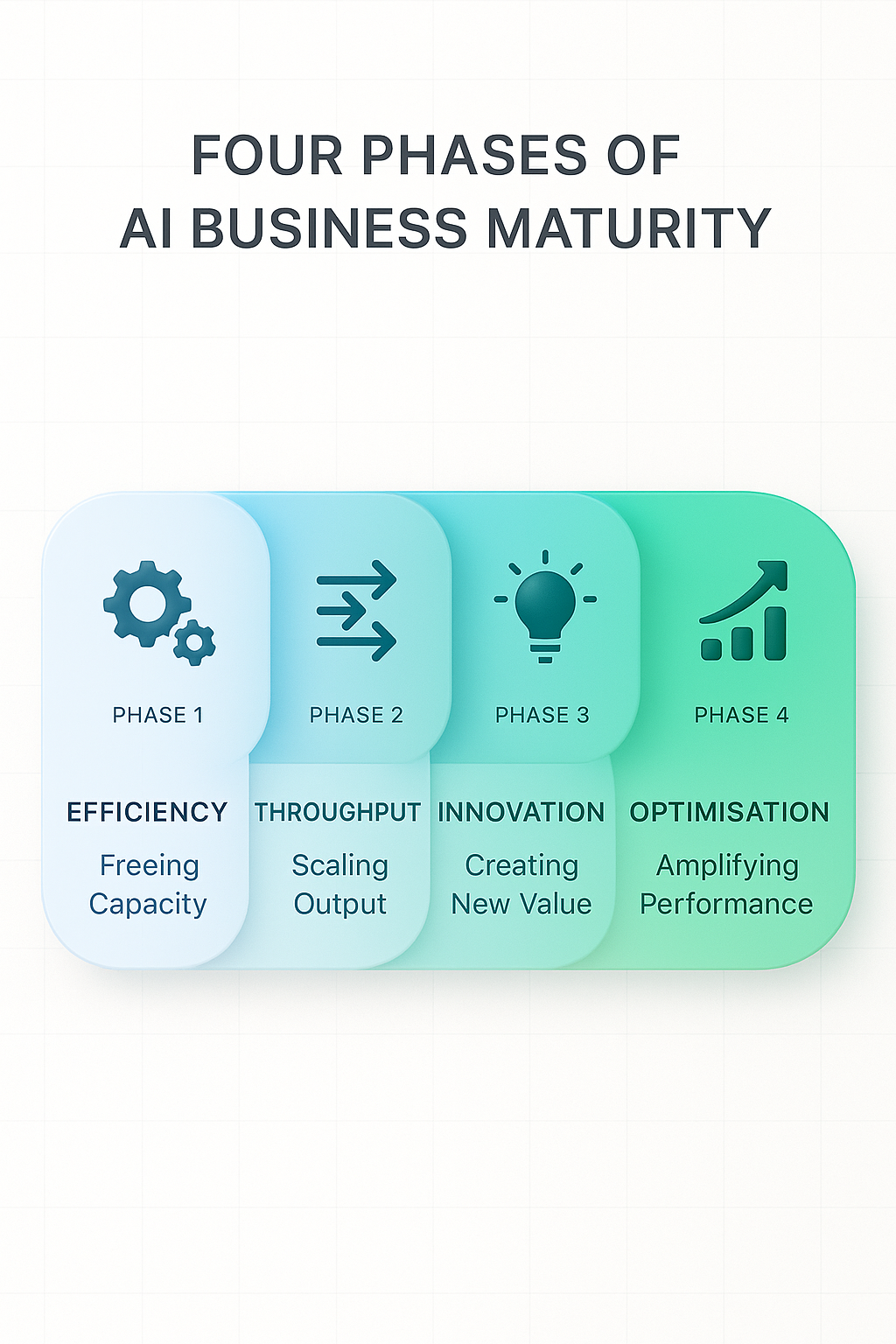
Eventually, every business hits a wall where automation can’t deliver more profit. AI can optimise operations only so far before it starts eroding differentiation.
- What happens: Margins improve temporarily, but growth stalls; the company becomes efficient but irrelevant.
- The opportunity: Shift from doing things better to doing better things. AI can help create entirely new products, services, and experiences, powered by human imagination - Innovation!
To sum it...
AI will replace tasks, not people. Those who adapt with critical thinking, imagination, and sound judgement will see their roles evolve and expand. Businesses that embrace human–AI collaboration will grow beyond efficiency, unlocking new levels of creativity, resilience, and meaning.
While no one can predict every choice business owners and staff will make, one thing is clear: AI will lower the cost of running a business. As barriers to entry fall, more ventures will emerge, creating more opportunities for people to work in environments shaped by thoughtful, visionary leadership.
Ultimately, leadership in the AI era is less about managing performance and more about curating possibilities, creating workplaces where curiosity, creativity, and collaboration can truly thrive.
How Cleverly AI Helps Teams Thrive
At Cleverly AI, we partner with businesses through every phase of AI maturity, from freeing capacity to unlocking innovation. Ensuring transformation extends beyond technology.
Our approach doesn’t end with an automation rollout. It starts with strategy and carries through to roadmap design, change management, training, and adoption. We help teams not only use AI : but truly work differently, creating lasting value through clarity, empowerment, and measurable outcomes.
By aligning people, process, and intelligent systems, we enable organisations to build confidence in change, nurture innovation, and turn productivity gains into long-term growth.
"From efficiency to empathy, that’s the real upgrade."
A Practical Path Forward
- Identify friction: where does work slow down or repeat?
- Automate the noise: use AI to remove wasted effort.
- Elevate the flow: reinvest saved time into creativity and innovation.
- Redefine value: focus on meaning, not motion.
Start building your AI-ready team — talk to Cleverly AI today.
Reference:
- Washington Post — Here’s what will really affect jobs in the age of AI
- McKinsey — Jobs Lost, Jobs Gained report
- Jobs and Skills Australia — Jobs & Skills Report 2024
- Australian Computer Society — Digital Pulse 2024
- Deloitte & RMIT Online — Ready, Set, Upskill report
- Australian Bureau of Statistics — Skills Development Data