

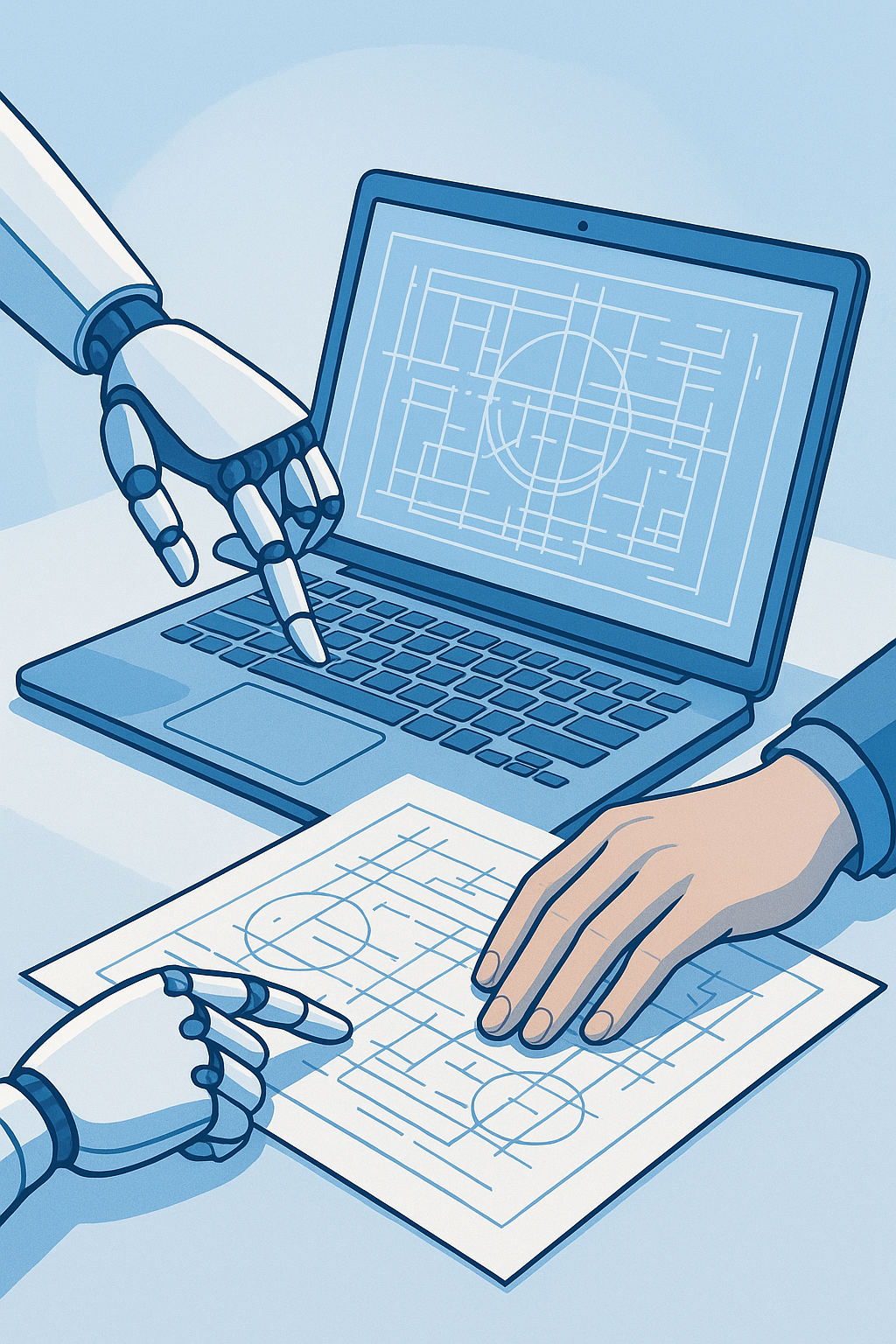

This article is part of a two-part series exploring how AI is transforming work.
Part A, The Mindset Shift, looks at how businesses and individuals can rethink the role of AI and build the foundation for an AI-enabled organisation.
Part B, The Human Shift, continues the conversation by focusing on people, how roles, leadership, and creativity evolve as humans and AI collaborate to shape the future of work.
Before We Begin: The Right Lens on AI
Before diving into AI’s impact on work, it helps to ground ourselves in what today’s tools can truly do, and what they can’t.
Right now, large language models (LLMs) outperform humans in three clear ways:
- They can read faster than humans.
- They can write faster than humans.
- They can analyse and synthesise massive amounts of data.
But it’s vital to remember what’s happening under the hood: An LLM (Large Language Model) is fundamentally a probabilistic model that predicts the most likely next word (or token) in a sequence based on patterns it has learned from vast amounts of text data. Its fluency often feels like intelligence, but accuracy still depends on human judgment.
A 2025 Washington Post analysis by Google’s chief economist Fabien Curto Millet and Cambridge professor Diane Coyle makes a similar point, the challenge isn’t AI’s power, but our readiness to use it wisely.
Think of AI as a better vehicle, not a new driver. As Henry Ford once said, people wanted faster horses and what they got was the car. In the same way, AI changes how we move forward, not who’s steering.
Perhaps a better metaphor: using AI is like stepping into an Ironman suit. With skill, it amplifies your power and speed, but you’re still the one inside. The outcomes, ethics, and responsibilities remain yours.
"AI is the suit. You are the superhero. Use it wisely."
The Future of Work Is Already Here
AI isn’t coming for our jobs., It’s coming for how we think about work.
The conversation has moved beyond job loss to something much more profound: job transformation. It’s not about what AI can take, but what it can help us become.
Instead of asking, "Will AI replace me?".
The better question is: "How will AI redefine who I can become?"
According to McKinsey’s 2025 report Superagency in the Workplace, the real barrier isn’t AI replacing people, it’s actually organisations failing to empower them to work effectively with AI.
Why Skills Trump Systems
AI is levelling the field, not just in what people can do, but in the value they can create.
On a task level, it allows anyone to perform complex or specialised work, such as data analysis or design, that once demanded advanced expertise or large budgets.
On a value level, it enables small businesses and their teams to compete with larger organisations by matching quality, speed, and innovation. In this sense, AI is democratising opportunity. Tools may evolve quickly, but human curiosity and adaptability remain constant.
The most valuable people in an AI-powered world aren’t those who master every platform or model, but those who can learn, unlearn, and reimagine how things work while applying critical thinking and sound judgement. The true advantage lies in creativity, empathy, connection, and the ability to use AI to drive better business outcomes faster.
According to the PwC Global AI Jobs Barometer 2025, roles most exposed to AI are expanding faster and earning up to 56 per cent higher wages. It's clear evidence that adaptability pays.
While many assume businesses will use AI to maximise profit by keeping salaries flat, the opposite is also true. As AI reduces operational costs, employees who know how to use it effectively to create measurable value will become even more valuable themselves. When workers leverage AI to produce stronger outcomes, businesses gain more capacity to reward that contribution, and the smartest organisations will.
“Automation frees time; imagination fills it.”
The Four Phases of AI Business Maturity
Every business sits somewhere on the AI maturity curve. Understanding your phase helps you know where to focus next.
- Phase 1: Efficiency - Freeing Capacity
Automate repetitive admin tasks like scheduling, invoice matching, or approvals to give people back time for higher-value work.
Measured by: Hours saved per week or reduction in task turnaround time. - Phase 2: Throughput - Scaling Output
Streamline workflows so teams deliver more with the same resources.
Measured by: Cycle time, error rate, and cost to serve. - Phase 3: Innovation - Creating New Value
Combine human creativity and AI capability to design new services or experiences.
Measured by: New product launches or service uptake. - Phase 4: Optimisation - Amplifying Performance
Use AI insights to fine-tune operations and margins.
Measured by: Continuous improvement loops and customer satisfaction scores.
Each phase moves your business closer to becoming AI-enabled: agile, creative, and human-centred.

"From efficiency to empathy, that’s the real upgrade."
A Practical Path Forward
- Identify friction: where does work slow down or repeat?
- Automate the noise: use AI to remove wasted effort.
- Elevate the flow: reinvest saved time into creativity and innovation.
- Redefine value: focus on meaning, not motion.
And this is just the beginning
Part A explored how shifting our mindset can unlock AI’s potential and reshape the way we work. But technology is only one half of the story.
In Part B - The Human Shift, we’ll explore what happens next: how roles, leadership, and creativity evolve as humans and AI collaborate to create something greater together. It’s where efficiency meets empathy, and where the real transformation begins.
Start building your AI-ready team — talk to Cleverly AI today.
Reference:
- Washington Post — Here’s what will really affect jobs in the age of AI
- McKinsey — Jobs Lost, Jobs Gained report
- Jobs and Skills Australia — Jobs & Skills Report 2024
- Australian Computer Society — Digital Pulse 2024
- Deloitte & RMIT Online — Ready, Set, Upskill report
- Australian Bureau of Statistics — Skills Development Data